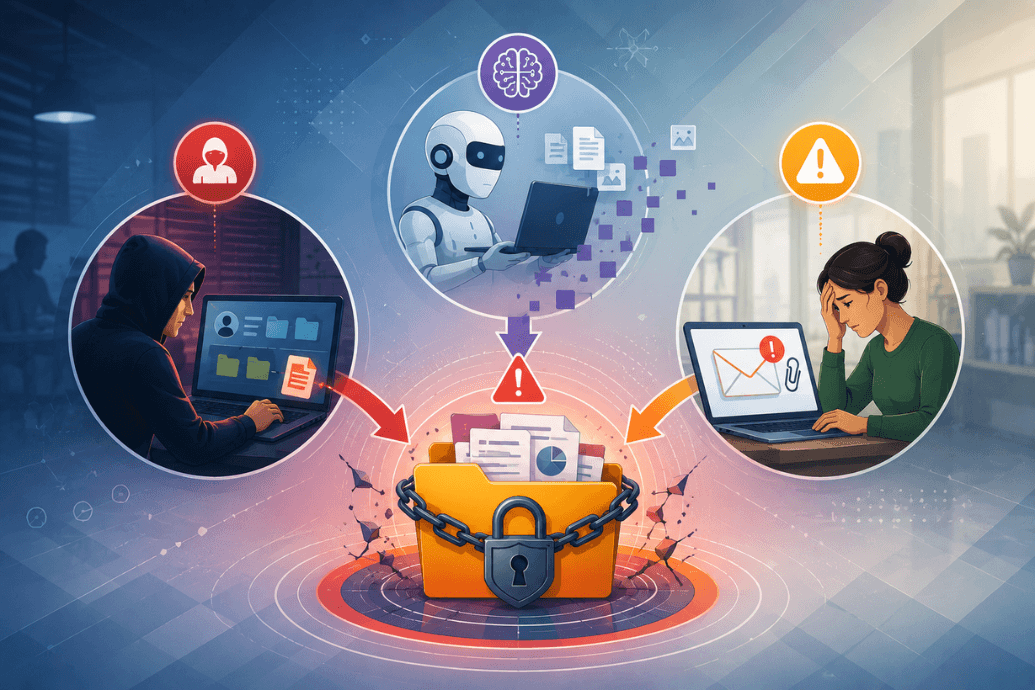
Insider threats are not always malicious. Many data security incidents begin with human error, weak access controls, cloud misconfigurations, or ungoverned AI use. This blog explains how insider threats, data leakage, and breach risks differ, and what organizations can do to reduce them.
A customer file is shared over a personal messaging app to speed up a conversation.
An employee copies sensitive information into an AI assistant to draft a report.
A cloud folder created for internal collaboration accidentally becomes accessible to external users.
These situations happen in organizations every day, which is exactly why they are easy to miss.
When people think about cyber threats, they often picture ransomware groups, sophisticated hackers, or large-scale attacks making headlines. But many serious incidents start inside the organization, through routine decisions, weak controls, excessive access, or simple human mistakes.
As organizations adopt cloud platforms, support hybrid workforces, and use AI-powered productivity tools, sensitive data now moves across more systems, devices, and applications than before. That makes it harder to track where critical information lives, who can access it, and how it is being used.
That is why insider threats, data leakage, and broader data breach risks deserve closer attention.
Not every incident is the result of malicious intent. A well-meaning employee can expose confidential information as easily as a bad actor can steal it. An unsecured cloud environment can create the same business impact as a targeted attack. And an AI tool used without proper safeguards can introduce risks that many organizations are only beginning to understand.
The organizations best prepared for today’s threat landscape are the ones that combine strong security controls with better governance, closer monitoring of data use, and earlier detection of risky behaviour.
Why Insider Threats Are a Growing Business Risk
For years, cybersecurity discussions have centered on external attackers. But many costly incidents start inside the organization, through misuse, mistakes, or weak controls.
According to the 2024 Cybersecurity Insiders Insider Threat Report, 83% of organizations experienced at least one insider-related attack within the previous year, while 48% reported that insider incidents have become more frequent.
At the same time, organizations are managing:
- Larger volumes of sensitive data
- More cloud applications
- Remote and hybrid workforces
- Increased third-party access
- Rapid adoption of generative AI tools
Together, these shifts create more ways for information to be exposed, whether through negligence or malicious intent.
That is why organizations are moving beyond perimeter-focused security and investing in better oversight of data access and usage.
What Exactly Is an Insider Threat?
An insider threat is any risk that comes from someone with legitimate access to an organization’s systems, applications, or data.
This includes:
- Employees
- Contractors
- Vendors
- Partners
- Former staff with lingering access
Because insiders already have trusted credentials and understand internal processes, suspicious activity is often harder to spot.
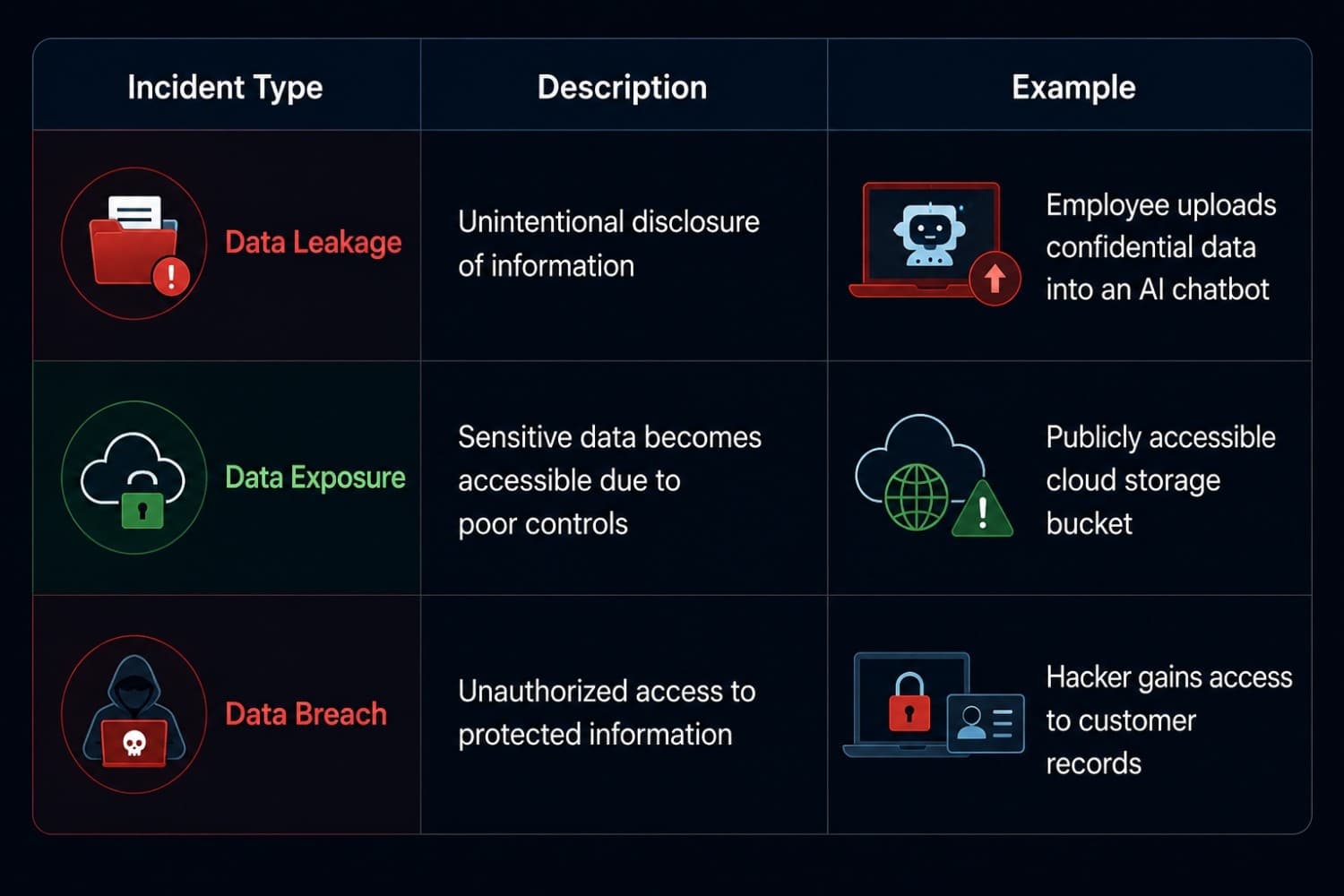
Data Leakage vs. Data Exposure vs. Data Breach: What Is the Difference?
Data leakage, data exposure, and data breaches are not the same. The difference matters because each one requires different controls and response measures.
For example:
- Data leakage often requires user awareness and monitoring.
- Data exposure requires stronger configuration management.
- Data breaches require threat detection and access control.
Organizations that fail to distinguish between these risks frequently leave significant security gaps unaddressed.
How AI Is Creating a New Data Leak Risk
Generative AI is helping teams work faster, but it is also creating a growing AI data leak risk. Employees increasingly use AI platforms to:
- Summarize reports
- Generate code
- Analyze contracts
- Draft presentations
- Create business documentation
AI creates data leak risk when employees enter confidential information into public or unapproved tools without governance, approved safeguards, or clear usage policies.
Real-World Scenario
A legal team member uploads a confidential contract into an AI assistant for summarization. The action may be well intentioned. The result may be the exposure of:
- Client information
- Pricing structures
- Intellectual property
- Regulatory-sensitive content
Microsoft's Digital Defense Report highlights how AI is expanding attack surfaces and creating new security challenges that organizations must proactively address.
Important: the issue is not AI itself, but unmanaged AI use around sensitive data.
Why Human Error Still Causes Data Security Incidents
Most employees do not intend to create security problems, but even capable teams make mistakes. Examples include:
- Misconfigured cloud storage permissions
- Sharing documents with incorrect recipients
- Clicking phishing links
- Storing sensitive files in personal applications
- Failing to follow access management procedures
Research consistently shows that negligent behaviour remains a leading cause of security incidents, yet many security programs still focus more on external threats than on everyday user actions.
Without clear visibility, risky actions can remain undetected until they escalate into a security incident.
How to Reduce Insider Threat and Data Leakage Risks
Reducing insider threats and data leakage starts with understanding how sensitive data is accessed, used, and shared. Organizations need the ability to understand:
- Who is accessing sensitive data
- When access occurs
- Why access occurs
- How information is being shared
- Whether activity aligns with policies
1. Implement Data-Centric Security
Protect the data itself rather than relying solely on network boundaries.
2. Strengthen Identity and Access Controls
Apply least-privilege principles and continuously review permissions.
3. Monitor User Behavior
Behavioral analytics can identify unusual access patterns before incidents escalate.
4. Govern AI Usage
Establish approved AI platforms and define clear policies for handling sensitive information.
5. Improve Cloud Security Visibility
As cloud adoption expands, organizations need continuous insight into data movement, permissions, and compliance posture.
This aligns closely with WinCap Consulting's approach to helping organizations strengthen cloud security, compliance, and governance through greater visibility and proactive risk management
Conclusion: The Biggest Security Risk May Already Have Access
Today’s insider threat, data leakage, and data breach risks often hide inside normal business activity. Human error, AI adoption, cloud complexity, and excessive access privileges are creating exposures that traditional perimeter-focused security cannot fully address.
Organizations that improve governance, monitor how sensitive information is handled, and respond to risky activity early are far better placed to reduce the impact of internal data incidents. The real question is whether your organization can spot these risks before they turn into costly breaches.
The real question is whether your organization has enough visibility to spot them early.
Explore Cloud Security & Compliance Solutions
Protect sensitive data, improve compliance, and gain clearer visibility into insider risks with WinCap Consulting’s cloud security and governance solutions.
Frequently Asked Questions About Insider Threats and Data Leakage
What is an insider threat in cybersecurity?
An insider threat is a security risk caused by someone with authorized access who intentionally or unintentionally misuses systems, data, or permissions.
What causes data leakage?
Data leakage is commonly caused by employee mistakes, cloud misconfigurations, weak access controls, unauthorized sharing, and improper use of AI tools.
How is data leakage different from a data breach?
Data leakage is usually accidental, while a data breach involves unauthorized access to protected information.
Why is AI increasing data security risks?
AI increases data security risk when employees enter confidential information into public or unapproved tools without proper governance.
How can organizations prevent insider threats?
Organizations can reduce insider threats through stronger data visibility, least-privilege access, behavior monitoring, cloud governance, employee awareness, and AI usage controls.